

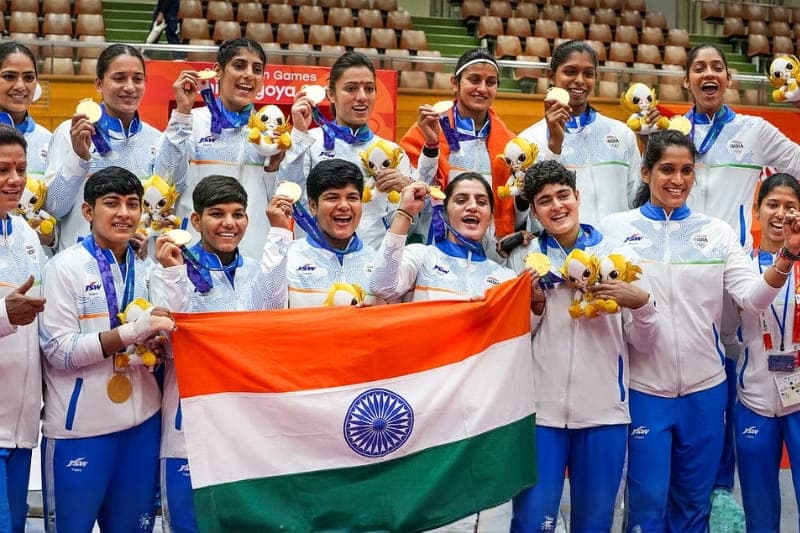
Every generation of an Indian kabaddi team inherits the same question. Can you carry the legacy? For India’s women, the question arrived in Aichi-Nagoya with even greater weight. They were not simply representing a country with a proud kabaddi history. They were defending a title.
Indian women’s kabaddi team had won gold in the Asian Games of 2010, 2014 and 2022. The only interruption had come in Jakarta in 2018, when Iran defeated them in the final. The defending champions arrived in Aichi-Nagoya with one objective: retain the gold medal they had won in Hangzhou. They left having done exactly that. But the journey was not simply a procession.
A Golden Legacy to Defend
Pushpa Rana was handed the captaincy, with Sonali Shingate as vice-captain. Ritu Negi, who had led India to gold in Hangzhou, remained in the squad as an experienced presence. Sanju Devi arrived with considerable momentum of her own after becoming MVP of India’s 2025 Women’s Kabaddi World Cup campaign.
Pooja Kajla added another experienced attacking option, while the squad also contained a mix of defenders and younger players ready for their biggest international stage. The expectation was enormous & so was the opportunity.
The Roaring Start
India opened their campaign against Bangladesh and immediately established their authority. The defending champions quickly established control in the opening stages of the game & won the game 42-21. Sanju Devi led the attacking charge while the defence kept Bangladesh from building any pressure.
Japan provided the next challenge but the Indian team were even more dominant on the host nation. India took control in the first half of the match as they were ahead by 32-13. Japan showed greater resistance after the break, but the gap was already too large. India eventually won 50-25, producing one of the biggest scorelines of their campaign.
India had started off their campaign with two wins, but the next challenge was a bigger one. Iran were not just another opponent. They were the team that had ended India's reign in the 2018 Asian Games final. Iran started the game aggressively & lead the game 8-4 at the end of 10 minutes. India needed an answer & Pooja Kajla provided it.
Her Super Raid changed the momentum, and another successful raid helped India level the contest. India reached half-time 19-15 ahead. India cruised through the second half & completed a commanding 37-23 victory over Iran. This win was more of a statement that India were no longer carrying the burden of 2018 & were here to dominate on the Asian stage once again.
The One That Got Away
After an amazing start to the campaign, India suffered their first league stage defeat to Chinese Taipei. It was a reminder to the defending champions that Asian Games gold was not guaranteed just because of their flawless start.
The defeat also changed the nature of the campaign. There was now pressure. India had to respond. And the response would come when the tournament entered the knockout stage.
No Room for Another Slip
The semi-final against Nepal was effectively a test of whether India had learned from the setback and the answer was emphatic. India took control and went into half-time with a 31-17 lead.
Their attack repeatedly found openings, while the defence prevented Nepal from building sustained momentum. India eventually completed a 48-24 victory. The defeat to Chinese Taipei had been answered, and India were in the final. And waiting there was Iran.
The Night India Refused to Give Up the Crown
If the league-stage meeting with Iran had been a statement, the final was a war of nerves. Iran had already tested India once. This time, the gold medal was on the line. The defending champions started well, leading 22-16 at half-time. But Iran refused to accept the script. The second half became a completely different contest. And Iran fought back to claim the gold.
Iran made a gritty comeback and reduced India’s advantage to just 27-26. For the first time in the tournament, India's gold medal looked genuinely vulnerable. And that was when the champions produced their biggest moments.
Sanju Devi delivered a crucial Super Raid, shifting momentum back towards India. Captain Pushpa Rana then helped India force an All-Out, creating much-needed breathing room. Pooja Kajla continued to attack the Iranian defence and helped India stretch the advantage. Iran fought tooth and nail to make a comeback in the dying moments of the final, but the Indian team showcased composure & grit to win another Asian Games gold.
The final score was; India 37 - 34 Iran. Three points between gold and silver. Three points between defending the title and surrendering it. India had done it again.
The Women Behind the Gold
Sanju Devi was one of India's most influential attacking players throughout the tournament. Her attacking contribution was particularly important in the biggest moments, culminating in the Super Raid that changed the final. Pooja Kajla was another key attacking outlet. Her turnaround against Iran in the league stage showed her ability to change the rhythm of a contest.
Pushpa Rana carried the leadership responsibility. The captaincy came with an expectation that India would win. When that expectation was tested in the final, she helped steady the team and push them towards the finish.
Ritu Negi & Sonali Shingate helped with the much needed experience required to win this gold. And collectively, the squad proved that India's women's kabaddi system had enough depth to withstand adversity.
A Golden Generation Built Through YKS
A part of that new golden generation had developed through the Yuva Kabaddi Series. Four members of India's women's squad had featured in the JSG Women's YKS. Nikita Kumari and Manisha Kumari had represented Murthal Magnets, while Bhavna Devi had played for Himalayan Tahrs.
Pushpa Rana had represented Himalayan Tahrs in the inaugural 2024 edition and finished as its Best Raider with 104 points in eight matches. Pushpa's progression was perhaps the clearest illustration of the pathway. Best Raider in the first Women's YKS. Indian captain at the Asian Games two years later. And now, an Asian Games gold medallist.
It was a small but significant indication of how India's emerging kabaddi ecosystem was feeding into the senior national team.
India’s Golden Run Continues
The easiest way to describe India's campaign is not simply by the gold medal. It is by the journey. There were convincing victories. There was a setback. There was a response. And then there was a final where everything came down to composure. India did not have a perfect campaign. They had something more valuable. A resilient one.
Four gold medals across five editions. Three consecutive titles. Another generation carrying the same legacy. The gold standard remained untouched.