

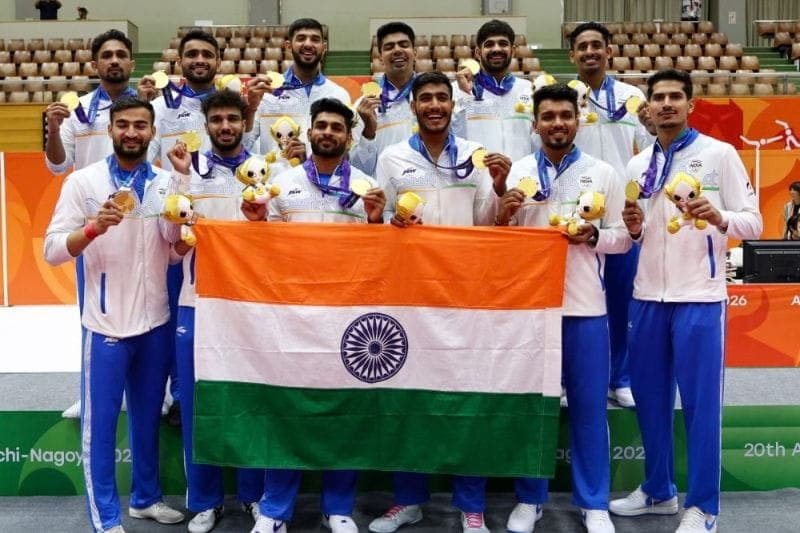
There are some victories that feel bigger than the final score. Some medals carry the weight of history, expectation and an entire sporting nation. For the Indian men's kabaddi team, the gold medal at the 2026 Asian Games in Aichi-Nagoya was all three.
India faced Iran on September 26, in the Tokai Citizens Gymnasium in Japan, the one opponent that has repeatedly challenged its supremacy in Asian kabaddi. 40 minutes later, the score was India 40, Iran 34. The gold belonged to India. The crown was protected, and a new generation of Indian kabaddi players had written their own chapter in the history of the sport.
India’s ninth men’s kabaddi gold medal at the Asian Games came without a single defeat. Four wins in the group stages, a commanding semi-final win, and then six points against Iran. Six games. Six wins. Gold medal.
But the story of this medal began long before that final whistle.
A New India Arrives
India entered Aichi-Nagoya as defending champions, but this was not quite the same team that had conquered Hangzhou. India's 12-man squad was a fascinating blend of proven international pedigree and fresh talent.
At the heart of this transition was captain Sunil Kumar, with Pawan Sehrawat, who led India in the last Asian Games, coming back as the deputy. Head coach Balwan Singh was on the sidelines. He was back in the role after a decade and with a formidable record of success in international kabaddi. The decision also reflected the huge impact of Pro Kabaddi League. Ayan Lohchab and Devank Dalal were the top two raiders in PKL Season 12, and Arjun Deshwal brings proven international experience. On the defensive front, Jaideep Dahiya and Gaurav Khatri stepped in after very productive domestic seasons.
The message was clear. India were not simply defending an old title. They were training the next champions.
League Stage Dominance
India began their campaign against hosts Japan with a 49-24 win, racing into a 31-9 half-time lead. Ashu Malik’s three-point Super Raid set the tone while Devank Dalal, Ayan Lohchab and Arjun Deshwal made sure the Japanese defense had little room to breathe.
The Republic of Korea were next, and India were even more ruthless. A 34-14 half-time advantage laid the foundation for a 63-31 win, with India's raiders collecting 38 raid points and the team inflicting three All-Outs.
Bangladesh briefly threatened to make things interesting after the break but India’s early 29-9 lead proved decisive in a 48-25 victory. India then finished the group stage with a controlled 37-21 win over Chinese Taipei.
Unbeaten after the League Stage, India finished as Group A leaders with a +64 points difference that underlined the balance between their attack and defence. The group stage had demonstrated India's firepower but more importantly, the squad was looking more settled. The debutants had just started to get used to the international stage & contributing to the team’s success in the best way possible.
Thailand & the Road to Final
Thailand stood between India & another Asian Games Final. In the first half, Thailand showcased their attacking quality & put pressure on the Indian team. Theeradet Chaisit produced a three-point Super Raid and helped Thailand briefly threaten India's rhythm. India responded fiercely with the players who had been performing at the highest level since the start of the tournament.
Devank Dalal and Arjun Deshwal repeatedly scored points, while Ayan Lohchab added another dimension to India's attack. Sumit Sangwan was enormous in the second half, producing key tackles and helping India close the contest. His interventions helped push Thailand further away, ensuring India would enter the gold-medal match with confidence.
The semi-final ended 66-28 & India had reached the Final for the 9th time in the history of Asian Games Kabaddi.
The Final Chapter
Iran is not just another kabaddi opponent for India. This rivalry has defined modern Asian Games kabaddi over the last decade. Iran ended India’s gold streak by defeating them in the semi-final in Jakarta 2018. India responded by beating Iran for the gold at Hangzhou. Ahead of the tournament, captain Sunil Kumar had already identified Iran as India's toughest opponent & the final proved him right.
For the first time in the tournament, India were pushed to the edge. Ali Samadi & Amir Mohammad Zafar Danesh kept the Indian defence occupied, while Mohammad Reza Shadloui continued to threaten from the attack.
At half time, Iran led 18-17 & India looked nervous. For a team accustomed to controlling Asian Games matches, this was unfamiliar territory.
The response from India’s defence was extraordinary after the break as Sumit and Jaideep Dahiya combined for a crucial Super Tackle on Ali Samadi, bringing India back into the contest. India’s Do-or-Die specialist, Aslam Inamdar, made a classic running toe touch to level the score.
The momentum had changed quickly & at the brink of the 30th minute, Arjun Deshwal went up against Iran captain Fazel Atrachali & got through. That raid helped India force an All Out and suddenly the defending champions had a five point lead over Iran. With ten minutes remaining the game was still alive but India’s defence had found another gear. Sumit Sangwan’s relentless back hold on Zafar Danesh, followed by Rahul Sethpal’s back hold on Shadloui, protected India’s advantage over the Iranians.
And when Iran pushed forward desperately, Aslam Inamdar responded with two valuable points. That was the difference between a team hoping to win gold and a team knowing how to close a final.
The clock ran down.
India 40. Iran 34.
Every Indian in the arena celebrated at the end of the final whistle as the new generation had won the Gold Medal for the country.
The Numbers Behind the Champions
India's 2026 campaign was built on balance. The attack was not dependent on one raider & The defence was not dependent on one defender. The team had options everywhere. The team did not simply rely on the veterans who had already tasted Asian Games glory. It trusted the next generation.
Devank Dalal was India's to raider across the tournament as he finished his campaign with 59 raid points to his name. His performances were strong enough to earn him the fans' vote as the tournament's favourite Indian player. For an Asian Games debutant, this was nothing short of a dream come true.
Arjun Deshwal was the big-match specialist. His most important contribution came when the final was still in the balance. Ayan Lohchab gave India speed and another high-volume attacking option, ensuring opposition defences could not focus on one primary raider. Ashu Malik made an immediate impact against Japan with his three-point Super Raid.
Aslam Inamdar was perhaps the most useful momentum player. He produced the do-or-die raid that levelled the final and then scored two crucial points when Iran were trying to mount one last comeback.
In defence, Sunil Kumar set the tone as captain. Sumit Sangwan became one of the defining defensive figures of the knockout rounds, first against Thailand and then Iran. Jaideep Dahiya stepped up in the biggest moment, combining with Sumit for the Super Tackle that shifted the final's momentum.
Rahul Sethpal, Gaurav Khatri and Ankit Jaglan added depth to a defensive unit that allowed India to maintain pressure throughout the tournament. And that is the important point about this gold. There was no passenger. Not every player needed to produce a headline performance. Together, they created something much more valuable than individual statistics: a team that could win in different ways.
The Next Generation
When the final whistle sounded in Aichi-Nagoya, India's gold medal tally in men's Asian Games kabaddi had reached nine. The defending champions had remained unbeaten throughout the tournament.
And for a brief moment, it did not matter who had scored the most points, who had made the most tackles or who had produced the biggest raid. They had all done the same thing. They had represented India. They had defended the crown.
A new generation of Indian kabaddi players learned what generations before them had already discovered
When India steps onto the kabaddi mat at the Asian Games, gold is not simply a target. It is a responsibility.